
Ste. Genevieve Parole Versus Probation
Missouri's Division of Probation and Parole supervises several legal statuses, but they do not begin the same way. Probation comes from a court judgment. It may let a person remain in the community instead of serving all or part of a jail or prison term. Parole comes through the Missouri Parole Board after a person has served part of a prison sentence. Conditional release is the supervised part built into many Missouri prison terms. All three can involve reporting rules, yet the source record and ending date differ.
A person who leaves the Ste. Genevieve County Detention Center is not automatically on parole or probation. Local release may follow bond, dismissal, time served, a court order, or transfer. The court docket or MODOC record must establish supervision. The comparison below keeps the custody event separate from the legal status that follows it.
| Status | Who orders it | Best verification |
|---|---|---|
| Probation | Sentencing court | Case.net judgment plus MODOC active record |
| Parole | Missouri Parole Board | MODOC active record and assigned field office |
| Conditional release | Statutory sentence structure | MODOC sentence data and field office |
| Final discharge | MODOC after the term ends | Historical Sunshine file or agency discharge record |
- Parole
- Supervised release from prison while the person remains in MODOC legal custody.
- Probation
- Court-ordered supervision in the community.
- Discharge
- The end of the supervision term and state authority for that case.
- Absconder
- A supervisee who has failed to remain available to the supervising agency.
Verify Ste. Genevieve Post-Release Supervision
Begin with the MODOC Offender Search. It covers active offenders, including probationers and parolees, after a CAPTCHA and name search. It does not show discharged offenders. A community assignment or parole or conditional-release status can establish that a person left prison but remains under MODOC authority. Match the DOC ID and other identifiers instead of relying on a same-name result.
- Search the person's first and last name, including a verified alias when needed.
- Match the DOC ID, offense county, status, and assignment shown in the record.
- Read the status carefully. Community supervision is not final discharge.
- Check Case.net for the Ste. Genevieve County judgment, probation order, warrant, or later docket entry.
- Use the MODOC district directory and confirm the assigned office with MODOC.
- If the active search has no result, review the historical Sunshine file or request a discharge record.
The active locator's omission of discharged people is vital. No result might reflect discharge, spelling, an alias, a data change, or another exclusion. The nightly MODOC Sunshine offender file includes people who are or have been under supervision, with records reaching back to 1974. Its completed flag, probation fields, assigned place, cause number, and sentence dates can help, but multiple charge rows must be reconciled.
Important: An active community record proves supervision, not the exact date a person walked out of the Ste. Genevieve County jail.
Ste. Genevieve District 12 Office
District 12 serves Ste. Genevieve, Madison, and St. Francois counties from the Farmington Community Supervision Center. It is not inside the county jail and is not a Ste. Genevieve-only office. Its official snapshot describes about 23 officers, around 50 clients per officer, and roughly 1,153 cases per year. Those figures describe the district, not the status of any one released person.
Farmington Community Supervision Center
1430 Doubet Road
Farmington, MO 63640
573-218-5006
Residence alone does not settle office assignment. Interstate compact supervision, a specialty caseload, a court direction, or an approved home plan can place a person elsewhere. Confirm the office shown in the person's MODOC record. For a general state inquiry, MODOC constituent services is available at 573-751-2389. Board questions can go to 573-751-8488.
Note: District 12 is the local starting point only after a court or MODOC record confirms that supervision exists.
Ste. Genevieve Supervision Violations
Conditions are the rules attached to probation, parole, or conditional release. Public supervision facts may include the present offense, judgment, conviction county, term, conditions, officer and office, custody or bond status, and a parole or conditional-release date. Confidential case notes are not automatically open. The signed court order, Board decision, and MODOC record control when sources differ.
An absconder has failed to stay available or comply with supervision. That status may lead to a warrant, arrest, a pause in earned credit, or revocation proceedings. No official Ste. Genevieve County absconder list was found. Search Case.net for warrant and hearing entries, then ask the assigned office for public status. Absence from an office list or online result does not clear a warrant.
Violations do not all cause the same result. MODOC or the court may continue supervision, change conditions, suspend credit, order a hearing, or return the person to custody under the governing process. A transfer back to jail is a new custody event. The Ste. Genevieve County released inmate search explains how to pair that event with the jail movement record.
Ste. Genevieve Supervision Discharge
Final discharge is not the same as release from prison. Under section 217.690, a parolee remains in MODOC legal custody. Conditional release under section 558.011 is also supervised. When the term and legal requirements end, discharge closes state supervision for that sentence. The person will generally no longer appear in the active locator.
Eligible people on probation, parole, or conditional release may receive Earned Compliance Credits under section 217.703, generally 30 days for each full compliant month. Exclusions, suspension, rescission, restitution, and a minimum period can affect the result. These credits shorten eligible supervision. They are not county-jail or prison good time. Section 217.705 supplies discharge mechanics.
For durable proof, request the discharge record with the DOC ID and cause number. MODOC's Sunshine file uses a completed flag and supervision fields, while the court docket may show a later satisfaction or order. Neither a missing active result nor the end of a jail booking proves discharge on its own.
Ste. Genevieve District 12 Intake
District 12 publishes an Intake Class and a community resource sheet with service, expectation, payment, and voluntary-resource information. This local layer matters after Ste. Genevieve County release because the tri-county field office, not the detention center, administers an assigned state supervision case. The class does not create parole or probation. A court judgment or Board and MODOC record does that.
Use the assigned officer's directions for reporting, approved residence, travel, payments, and programs. Do not assume that every person released at Basler Drive must report in Farmington. A person released on bond may have court conditions but no MODOC case. Someone transferred to a Missouri prison has not entered community supervision at all. The official District 12 page and its resource PDF identify the local office's actual services.
This distinction prevents a common error. County jail status, court supervision, and MODOC supervision are separate records. Confirm each before acting on a release plan.
Ste. Genevieve Parole Hearing Records
The Missouri Parole Board schedules eligibility hearings under its rules and sentence-length guidance. Missouri does not publish a named, date-specific hearing calendar or a person-by-person decision search. Hearing and duty-created materials have confidentiality limits under sections 217.670 and 549.500. The institutional parole office or Board is the route for an individual's date and authorized information.
A hearing is not a release order. The result may set a later hearing, a presumptive parole date, release at a conditional or maximum date, or another outcome allowed by rule. Decisions commonly take eight to twelve weeks, and a presumptive date can later change. The Board process should be read with any minimum term that applies to the sentence.
The official hearing process explains the sequence. MOVANS-registered victims may receive a decision notice, but that enrollment is distinct from a public VINELink status search. Note: A parole hearing outcome is a legal decision record, not proof of the jail or prison door-exit time.
The official parole-hearing page shows the process used for Missouri cases.
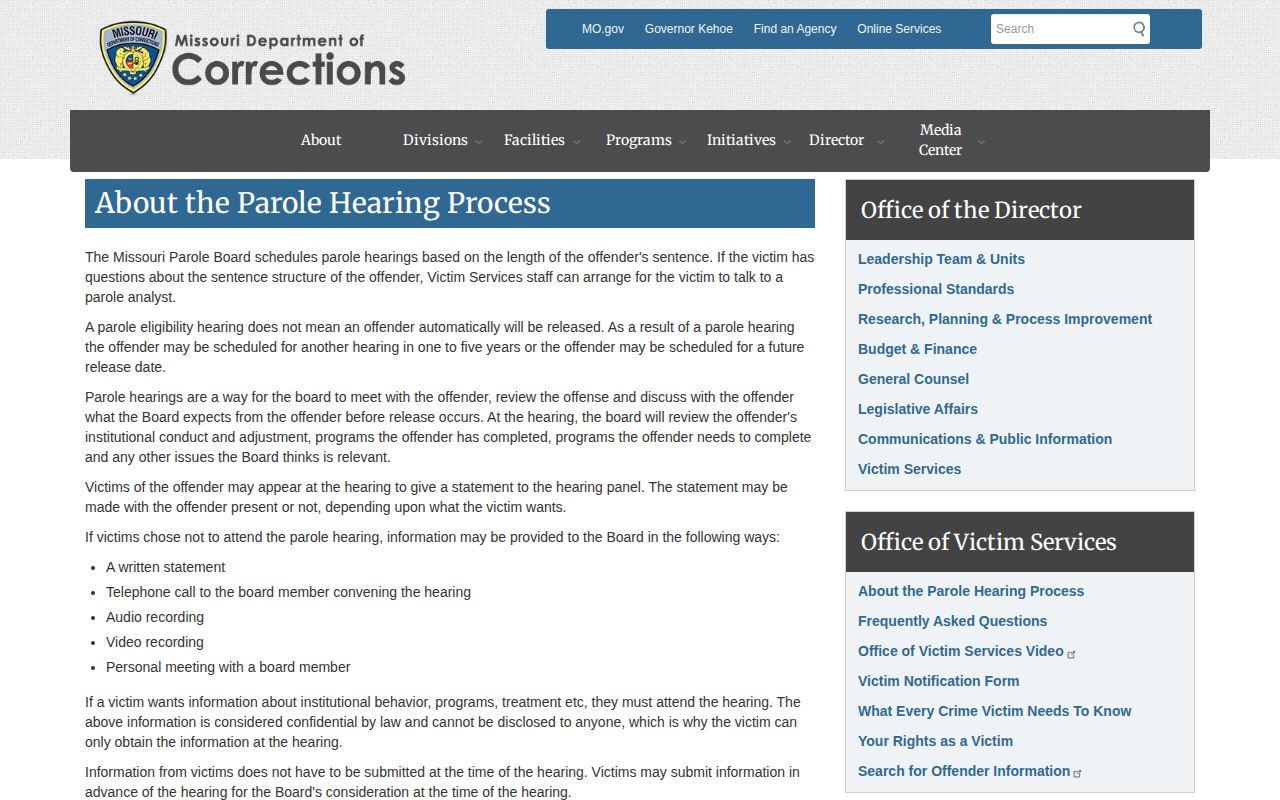
Its timing and outcome language helps distinguish eligibility, a tentative release date, and actual release.
Eligibility also depends on the sentence. Section 217.690 gives the Board parole authority but does not require release or reduce the judgment. Section 558.019 can impose minimum terms, including the 85-percent rule for a statutorily defined dangerous felony. That percentage is an eligibility threshold in covered cases, not a promised release point. Consecutive sentences may also combine minimum terms under the governing rules.
For a Ste. Genevieve County case, match the Board process to the sentencing docket and DOC ID. The court shows the judgment. MODOC shows active status and assignment. The Board or institutional parole office supplies authorized case-specific information. After a release event, District 12 verifies field supervision only if that office is truly assigned.